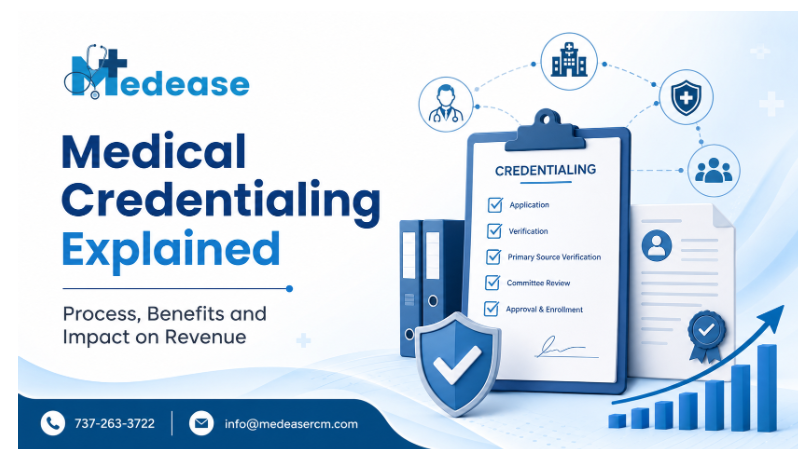
Medical credentialing is one of the first steps a healthcare provider must complete before billing insurance payers. It confirms that a provider has the right education, license, training, and professional background to deliver care.
For medical practices, credentialing is not just paperwork. It affects payer enrollment, claim approval, reimbursement, and cash flow. If credentialing is delayed or incomplete, providers may not be able to bill for services, even when the care was properly documented with the right CPT and ICD-10 codes.
This is why medical credentialing should be managed carefully from the start. A clean credentialing process helps practices avoid payment delays, reduce denials, and protect revenue.
What Is Medical Credentialing?
Medical credentialing is the process of checking and verifying a healthcare provider’s qualifications before the provider can work with patients, hospitals, insurance companies, Medicare, Medicaid, or private payer networks.
It helps confirm that the provider is properly trained, licensed, and eligible to deliver medical services.
What Are Medical Credentials?
Medical credentials are the documents and records that prove a provider’s professional qualifications. These may include:
- Medical license
- NPI number
- DEA registration, if required
- Board certification
- Education and training history
- Residency or fellowship records
- Work history
- Malpractice insurance
- Professional references
- CAQH profile
- Any history of sanctions or disciplinary actions
These credentials help payers and healthcare organizations decide whether a provider can join their network or deliver services under their system.
In medical billing, these details matter because payer systems must recognize the provider before claims can be submitted and paid correctly. If the provider is not credentialed or enrolled correctly, claims may be denied, delayed, or rejected.
What Is Medical Staff Credentialing?
Medical staff credentialing is the process hospitals, clinics, group practices, and healthcare organizations use to verify providers before allowing them to treat patients within their facility or network.
It can apply to:
- Physicians
- Nurse practitioners
- Physician assistants
- Therapists
- Counselors
- Dentists
- Specialists
- Other licensed healthcare professionals
Medical staff credentialing helps healthcare organizations protect patients and meet compliance standards. It also supports billing accuracy because the provider’s role, specialty, license, and payer status must match the services being billed.
For example, if a provider performs a service but is not properly credentialed with the payer, the practice may face reimbursement delays. Even if the CPT code, ICD-10 code, and documentation are correct, the claim can still fail because the provider is not approved in the payer’s system.
Why Medical Credentialing Matters in Healthcare
Medical credentialing protects patients, supports compliance, and helps providers get paid for the services they perform.
It connects clinical qualifications with payer approval, which makes it important for both patient care and revenue cycle management.
Patient Safety and Provider Trust
Credentialing helps confirm that a provider is qualified to deliver care. Before a provider joins a practice, hospital, or payer network, their license, training, education, and professional history must be checked.
This process helps reduce risk for patients and healthcare organizations. It also builds trust because patients expect their provider to be properly licensed, trained, and approved to treat them.
For practices, this trust is important. A provider with complete and verified credentials is easier to enroll with payers and easier to manage from a billing standpoint.
Compliance With Payer and Regulatory Requirements
Healthcare payers have strict rules before they allow a provider to join their network. Medicare, Medicaid, commercial insurance plans, and managed care organizations may all require credentialing before claims can be submitted.
Credentialing also helps practices stay aligned with:
- State licensing rules
- CMS requirements
- Medicaid enrollment rules
- Medicare enrollment rules
- Payer contract requirements
- Internal compliance policies
If these requirements are not met, the practice may face denied claims, delayed reimbursement, or payer enrollment issues.
This is why medical credentialing should never be treated as a one-time task. Provider records must stay updated, especially when licenses, malpractice coverage, CAQH profiles, or payer contracts change.
The medical credentialing process includes collecting provider details, verifying credentials, submitting payer applications, and tracking approval dates.
A strong process helps the practice avoid billing problems before claims are submitted.
Step 1: Collect Provider Information
The first step is gathering all required provider documents. This information must be complete and accurate because payers use it to decide whether the provider can join their network.
Common credentialing documents include:
- NPI number
- CAQH profile
- Medical license
- DEA registration, if applicable
- Board certification
- Education and training history
- Work history
- Malpractice insurance
- Tax ID and practice information
- W-9 form
- Professional references
- Any history of sanctions or disciplinary actions
This step is important because even one missing document can delay the full medical credentialing process.
Step 2: Verify Credentials
After the documents are collected, the information must be verified. This is often called primary source verification.
Primary source verification means checking the provider’s information directly with the original source. For example, a medical license may be verified through the state licensing board. Education may be checked with the medical school or training program.
This step helps confirm that the provider’s credentials are real, active, and in good standing.
Step 3: Submit Payer Applications
Once the provider’s credentials are ready, applications are submitted to insurance payers. This may include commercial insurance plans, Medicare, Medicaid, or managed care organizations.
This part is also known as payer enrollment or insurance credentialing.
Each payer may have different requirements. Some payers use CAQH. Others may require separate forms, contracts, or portal submissions.
For Medicaid credentialing, requirements can also vary by state and provider type. A therapist, nurse practitioner, physician assistant, or dental provider may need different documents based on state Medicaid rules.
Step 4: Track Approval and Effective Dates
Submitting the application is not the final step. The practice must follow up with payers and track the approval status.
The effective date is very important in medical billing. This is the date when the provider becomes active with the payer. If claims are submitted before the effective date, they may be denied or delayed.
A practice should track:
- Application submission date
- Payer follow-up dates
- Missing document requests
- Approval date
- Contract status
- Effective date
- Recredentialing deadline
Good tracking helps prevent revenue loss. It also makes sure billing starts only when the provider is fully approved.
Medicaid Credentialing and Provider Enrollment
Medicaid credentialing is the process of enrolling an eligible provider with a state Medicaid program or Medicaid managed care plan.
This step allows the provider to treat Medicaid patients and receive reimbursement for covered services.
How to Get Credentialed With Medicaid
To get credentialed with Medicaid, the provider usually needs to complete a state Medicaid enrollment application and submit required documents.
The process may include:
- Verifying the provider’s license
- Confirming the NPI number
- Submitting tax and practice details
- Providing malpractice insurance information
- Completing provider enrollment forms
- Linking the provider to a group practice, if needed
- Completing payer or managed care plan applications
- Waiting for approval and an effective date
Medicaid credentialing is not exactly the same in every state. Texas Medicaid, Mississippi Medicaid, Illinois Medicaid, Virginia Medicaid, North Carolina Medicaid, and South Carolina Medicaid may each have their own rules, portals, provider types, and processing timelines.
This is why practices should check state-specific requirements before submitting the application.
Can Providers Credential With Medicare and Medicaid at the Same Time?
Yes, many providers can start Medicare and Medicaid credentialing at the same time. This can save time, especially when a new provider is joining a practice.
However, Medicare and Medicaid are separate programs. Each has its own application, review process, documentation requirements, and approval timeline.
A provider should not assume that Medicare approval automatically means Medicaid approval. The practice must track both enrollments separately.
Medicaid Credentialing for Therapists, Nurse Practitioners, Physician Assistants, and Dental Practices
Medicaid credentialing can apply to different provider types, including therapists, nurse practitioners, physician assistants, LPCs, and dental providers.
The exact rules depend on the state Medicaid program and the payer network.
For example:
- A nurse practitioner may need state license verification, NPI details, and supervising or collaborating provider information, if required by state rules.
- A therapist may need license verification, specialty details, and Medicaid provider enrollment approval.
- A physician assistant may need documentation based on state scope of practice rules.
- A dental practice may need provider enrollment, location details, and service-specific approval.
Being credentialed with Medicaid can affect a practice’s ability to serve Medicaid patients and receive payment for covered services. Without proper Medicaid enrollment, claims may be denied even when the service is medically necessary and correctly coded.
How Long Does Medical Credentialing Take?
Medical credentialing usually takes several weeks to a few months. The exact timeline depends on the payer, provider type, state rules, document accuracy, and how quickly missing information is corrected.
A clean and complete application can move faster. An incomplete file can delay billing and reimbursement.
Typical Medical Credentialing Timeline
In many cases, medical credentialing can take 60 to 120 days. Some payers may approve faster, while others may take longer.
The timeline may include:
- Document collection
- CAQH profile review
- License and certification verification
- Payer application submission
- Payer review
- Contracting, if required
- Final approval
- Effective date confirmation
Medicaid credentialing can also take time because each state may have its own process. Some Medicaid applications move quickly, while others may take several months depending on state workload and provider type.
For example, Texas Medicaid, Mississippi Medicaid, Virginia Medicaid, Illinois Medicaid, North Carolina Medicaid, and South Carolina Medicaid may each have different timelines and enrollment rules.
Why Credentialing Gets Delayed
Credentialing delays are common when provider information is missing, outdated, or incorrect.
Common reasons include:
- Expired medical license
- Incomplete CAQH profile
- Wrong NPI or Tax ID details
- Missing malpractice insurance
- Unclear work history
- Missing DEA registration, if required
- Name mismatch across documents
- Payer portal errors
- Slow payer response
- Missing effective date confirmation
These delays can create serious billing problems. A provider may start seeing patients, but the practice may not be able to submit clean claims until payer approval is complete.
This is why credentialing should begin early, ideally before the provider starts seeing patients. Good planning helps protect cash flow and reduces avoidable denials.
How Much Does Medical Credentialing Cost?
Medical credentialing cost depends on the provider type, payer count, specialty, state rules, Medicare or Medicaid enrollment needs, and whether the practice manages the work internally or outsources it.
There is no single fixed price for every provider. A solo provider joining three commercial payers will usually cost less than a multi-provider group enrolling with Medicare, Medicaid, and several commercial plans.
| Credentialing Cost Type | Real-World Price Range | What It Usually Covers |
| Per payer credentialing | $100 to $500 per payer | Application preparation, payer submission, follow-up, and status tracking |
| Commercial insurance panel enrollment | $100 to $200 per application | Joining insurance networks so the provider can bill that payer |
| Full credentialing bundle | $1,200 to $2,000 for 8 to 10 payers | Multiple payer applications for one provider |
| Annual physician credentialing cost | $2,000 to $3,000 per year | Ongoing credentialing work, renewals, payer maintenance, and admin time |
| Complete outsourced physician credentialing | $2,500 to $5,000 per physician | End-to-end credentialing support by a third-party service |
| Medicare institutional provider application fee | $750 in 2026 | CMS enrollment application fee for applicable institutional providers |
| CAQH Provider Data Portal | Free for healthcare providers | Providers can enter, maintain, and share professional and practice information |
Cost Factors Practices Should Consider
The lowest price is not always the best option. A cheap credentialing service can become expensive if applications are submitted incorrectly, payer follow-up is missed, or effective dates are not tracked.
Common cost factors include:
- Number of providers being credentialed
- Number of insurance payers involved
- Medicare or Medicaid enrollment requirements
- State-specific Medicaid rules
- Provider specialty and license type
- Group practice setup
- CAQH profile setup and maintenance
- Recredentialing and renewal tracking
- Payer contracting needs
- Urgency of the application
Key Benefits of Medical Credentialing for Providers and Practices
Medical credentialing helps practices stay compliant, enter payer networks, reduce billing risk, and improve reimbursement flow.
It also gives providers a stronger foundation for patient care, claim submission, and long-term revenue cycle performance.
Better Payer Access
Credentialing allows providers to become approved with insurance payers. Once approved, the provider may be able to participate as an in-network provider.
This matters because in-network status can help practices:
- Reach more insured patients
- Improve patient access
- Build payer relationships
- Submit claims under approved contracts
- Reduce out-of-network billing issues
Without proper payer enrollment, the provider may not be able to bill certain insurance plans. This can limit patient volume and reduce revenue opportunities.
Stronger Cash Flow
A complete credentialing process helps reduce payment delays. When payer records are correct, claims are more likely to process smoothly.
This supports stronger cash flow by reducing:
- Enrollment-related denials
- Claim rejections
- Pending claims
- Manual billing corrections
- Delayed provider payments
For a medical practice, timing matters. If credentialing is completed before the provider starts seeing patients, the billing team can submit claims with fewer problems from the beginning.
Reduced Administrative Risk
Credentialing also helps practices stay organized. Provider records must be accurate, updated, and ready for payer reviews, audits, renewals, and recredentialing.
Important records include:
- Active licenses
- CAQH updates
- Malpractice coverage
- DEA registration
- Payer approval letters
- Effective dates
- Contract details
- Recredentialing deadlines
When these records are managed properly, the practice can respond faster to payer requests. This reduces stress on billing teams and lowers the risk of preventable revenue loss.
Common Medical Credentialing Mistakes to Avoid
Many credentialing problems happen because small details are missed during document collection, payer submission, or follow-up.
These mistakes can delay approval, create billing issues, and affect reimbursement.
Incomplete Provider Applications
Incomplete applications are one of the most common reasons for credentialing delays. Payers may pause the review process if required details are missing.
Common missing items include:
- Updated medical license
- Current malpractice insurance
- Complete work history
- Correct NPI number
- Tax ID information
- Practice location details
- DEA registration, if required
- Signed provider forms
Before submission, every application should be reviewed carefully. This helps reduce payer requests for corrections and keeps the process moving.
Outdated CAQH Information
Many commercial payers use CAQH to review provider information. If the CAQH profile is outdated, incomplete, or not re-attested, payer approval can be delayed.
Practices should keep CAQH updated with:
- Current license details
- Practice address
- Malpractice insurance
- Board certification
- Work history
- Contact information
- Disclosure questions
A clean CAQH profile makes payer enrollment smoother and reduces unnecessary back-and-forth with insurance companies.
Missing Effective Date Tracking
The effective date is the date when a provider becomes active with the payer. This date is very important for medical billing.
If claims are submitted before the effective date, they may be denied. If the billing team does not know the correct date, they may submit claims too early or under the wrong provider setup.
Practices should track payer approval letters, contract status, and effective dates in one organized system.
Waiting Too Long to Start Recredentialing
Credentialing does not end after the first approval. Providers must go through recredentialing or renewal based on payer and regulatory requirements.
Waiting too long can create gaps in payer participation. These gaps may lead to claim denials, payment delays, or loss of network status.
To avoid this, practices should monitor:
- License expiration dates
- Malpractice insurance renewals
- DEA renewal dates
- CAQH re-attestation deadlines
- Payer recredentialing deadlines
- Medicaid and Medicare updates
How MedEase RCM LLC Helps With Medical Credentialing
MedEase RCM LLC helps healthcare providers manage credentialing with better accuracy, follow-up, and billing readiness.
Our goal is to reduce payer enrollment delays, prevent avoidable denials, and help practices protect revenue from the start.
Credentialing Support for Providers
MedEase RCM LLC helps providers organize and prepare the documents needed for medical credentialing.
This may include:
- Provider demographic details
- NPI and Tax ID information
- State license details
- DEA registration, if required
- Malpractice insurance
- CAQH profile information
- Education and training history
- Work history
- Payer-specific forms
Having the right documents ready helps reduce delays during payer review.
Payer Enrollment and Follow-Up
Credentialing does not stop after submitting an application. Payers often request updates, corrections, or missing details.
MedEase RCM LLC helps track payer applications, follow-up dates, approval status, and effective dates. This makes it easier for billing teams to know when a provider is ready to submit claims.
Accurate follow-up also helps prevent revenue loss caused by missed payer responses or incomplete enrollment.
Conclusion
Medical credentialing is a key part of healthcare billing, compliance, and revenue protection. It confirms that providers have the right credentials, payer approval, and enrollment status before claims are submitted. When credentialing is handled correctly, practices can reduce denials, avoid payment delays, and improve reimbursement flow. Strong documentation, accurate CPT and ICD-10 coding, and active payer enrollment all work together to support a healthier revenue cycle.